
Heropool: Designing a Safe and Flexible Commute for Frontline Workers[Part 2]
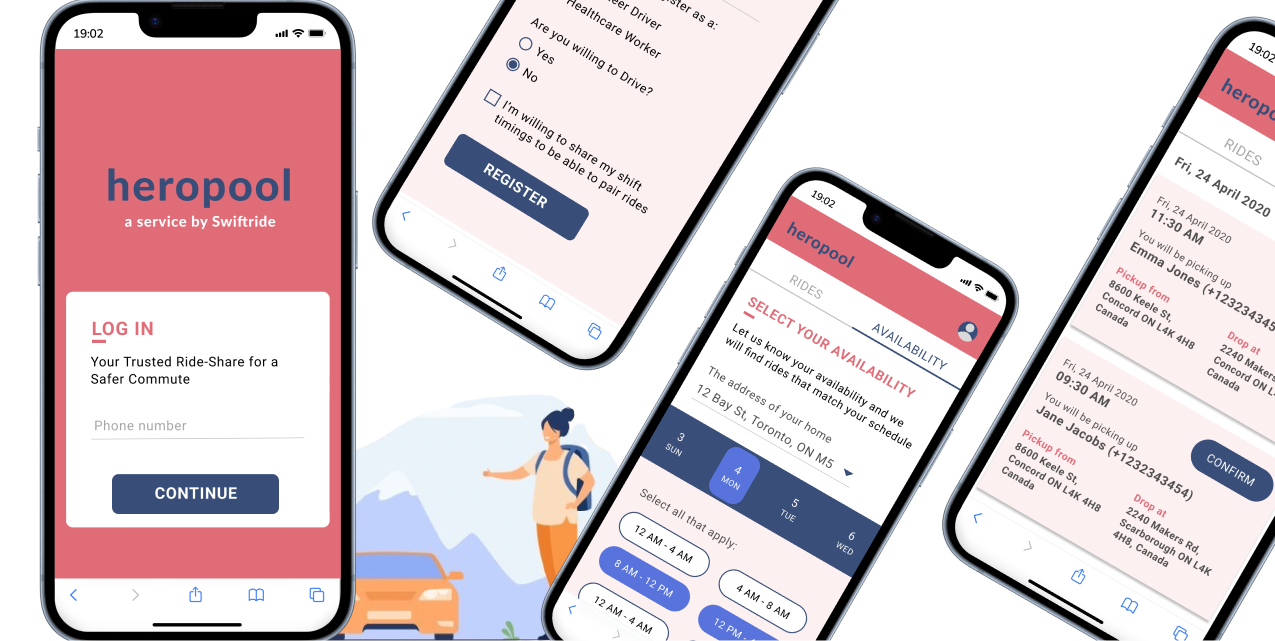
Turning the Heropool concept into a simple ride-pairing experience built around work shifts, safety, and reliability.
Once we understood the problem frontline workers were facing, our challenge shifted from “What should we build?” to “How can we make this experience simple enough to use during an already stressful time?”
Heropool needed to coordinate riders, drivers, work schedules, routes, and sanitation—without making the experience feel complicated.
My role focused on Product Strategy, Visual Design, Onboarding Documentation, and Usability Testing.
Designing Around Three Types of Users
We identified three primary ways someone could participate in the Heropool network:
Frontline worker looking for a ride
Needs a reliable ride that fits their work schedule.Frontline worker willing to drive
Can offer a ride when their route and shift align with another worker.Volunteer driver
Can support frontline workers when an existing ride match isn't available.
The Four Principles Behind the Design
Every feature was evaluated against the core benefits we wanted Heropool to deliver:
Zero-cost service
Support frontline workers without adding another financial burden.Flexibility
Coordinate rides around work shifts and minimize waiting.Safety
Make sanitation and protective measures visible parts of the service.Reliability
Build a dependable transportation network around colleagues and volunteers.
Key Design Milestones
One-Step Account Registration
The first principle was simple: don't make registration another barrier.
We designed the experience so that a phone number was sufficient to log in and access rides.
During onboarding, users could identify themselves as:
Frontline worker looking for a ride
Frontline worker willing to drive
Volunteer driver
The goal was to get users into the experience quickly while capturing the information needed to make the ride network work.
Matching Rides Around Work Shifts
Traditional carpooling focuses primarily on destination and route.
Heropool had another critical variable: work shift timing.
Frontline workers and volunteers could enter their daily shift schedules into the application. The ride-pairing algorithm was designed to run every six hours and identify potential matches based on
Nearby locations
Similar work-shift timings
Driver availability
The idea was to create a commute network that worked around people's actual working schedules rather than forcing them into fixed transportation windows.
Making Sanitation Part of the Experience
Safety couldn't just be communicated as a message. We wanted sanitation to become part of the actual ride workflow.
We explored a trial partnership with a car-cleaning service provider to offer sanitation services and planned to provide drivers with PPE at a central location before passenger pickup. Within the product, drivers were prompted to confirm the sanitation activity before a ride.
The application couldn't independently verify whether a vehicle had been sanitized, so the feature intentionally worked as a reminder and accountability step, rather than pretending to provide verification.
Ride Status
Once a driver accepted a pickup or drop-off, the ride moved into a scheduled ride state. This gave users a simple way to understand:
What rides have I requested? → Which rides have been accepted? → What rides are scheduled?
The goal was to reduce uncertainty around daily transportation and make the experience predictable.
Designing the End-to-End Flow
We mapped the experience from registration through ride completion, focusing on the minimum number of steps required to successfully coordinate a commute.
The core journey became:
Register → Select your role → Enter your schedule → Find a match → Accept the ride → Confirm sanitation → Complete the commute
This helped us keep the experience focused while still supporting the operational needs behind the service.
Prototype & Testing
Given the two-week sprint, we focused on prototyping the core experience rather than attempting to build a fully scaled mobility platform.
We used prototypes to communicate the service model, test the primary flows, and identify areas where the experience could be simplified.
Usability testing and feedback became particularly important because our users were operating in a high-pressure environment. A feature that might seem small from a product perspective could become unnecessary friction for someone trying to get to a shift.
What the Design Taught Me
The biggest takeaway was that good emergency products don't necessarily need more features—they need fewer barriers.
Heropool taught me to design beyond screens and interactions, connecting user needs, business constraints, technology, and service operations into one cohesive experience. Most importantly, it reinforced a principle I carry into my product work: when the situation is complex, the experience should feel simple.

