
Heropool : From Carpooling to Supporting Frontline Workers [Part 1]
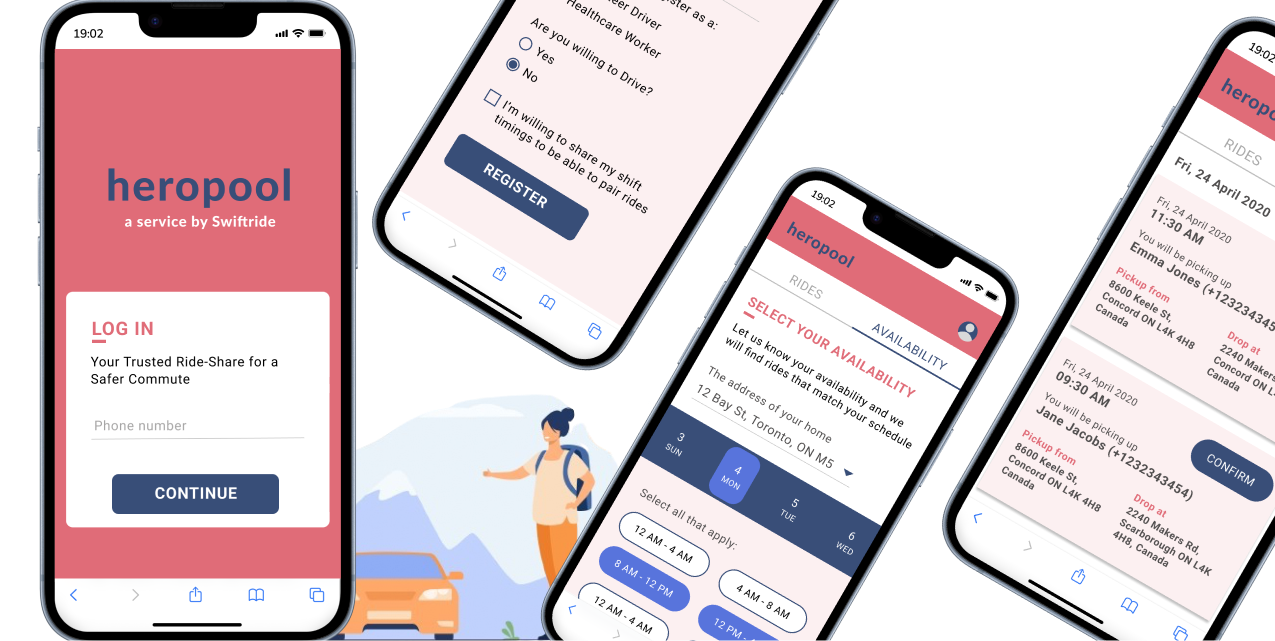
How a Toronto mobility startup pivoted its carpooling platform to help frontline workers commute safely during the COVID-19 pandemic.
With a motive to serve the community during the pandemic, Swiftride, a Toronto-based mobility startup, set out to create a frictionless commute solution for frontline workers.
The result was Heropool—a ride-pairing service designed to help frontline workers plan and coordinate daily rides around their work shifts, while addressing concerns around flexibility, reliability, and sanitation.
Our team won First Prize at TogetherVsVirus 2020 and was a Semi-finalist at Hack the Curve, two Canada-wide hackathons, for proposing a solution to help reduce understaffing at care home facilities.
My role: Product Strategy · Visual Design · Onboarding Documentation · Usability Testing
Looking Beyond the Obvious Problem
Swiftride was a Toronto-based mobility startup originally working on a carpooling solution. But as the pandemic unfolded, we began questioning whether transportation could be contributing to the staffing shortages at care facilities.
We reached out to managers at care home facilities to understand what was preventing frontline workers from taking their shifts.
Our conversations revealed two recurring concerns:
Lack of flexibility in public transportation
Fear of getting infected during the daily commute
The problem wasn't simply that care facilities didn't have enough staff. Many frontline workers were willing to work, but getting to work safely had become a barrier.
The Pivot
Swiftride had originally been developing a carpooling application. But as the pandemic changed people's mobility needs, we realized that the original product no longer addressed the most urgent problem.
Rather than continue building the existing application, the team put development on hold and pivoted toward a service specifically designed around the needs of frontline workers.
Create a safe, reliable, and flexible transportation network that helps frontline workers get to and from work with less risk and friction.
This became the foundation for Heropool.
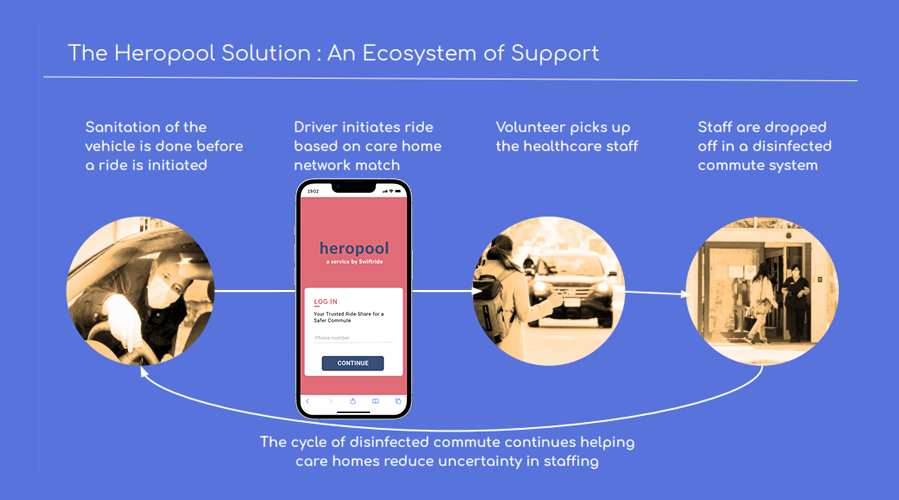
The Big Idea : A Sanitized Commute Network
We proposed Heropool, a ride-pairing service that would match frontline workers looking for a ride with frontline workers or volunteers traveling a similar route.
The concept was built around three needs we had uncovered through our research:
Flexibility — rides needed to work around unpredictable shift schedules.
Reliability — frontline workers needed confidence that they could get to and from work.
Safety — sanitation and protective measures needed to be part of the commute experience.
We also explored creating a pool of screened volunteer drivers who could fill gaps when a frontline worker didn't have a suitable ride match.
Designing Within Constraints
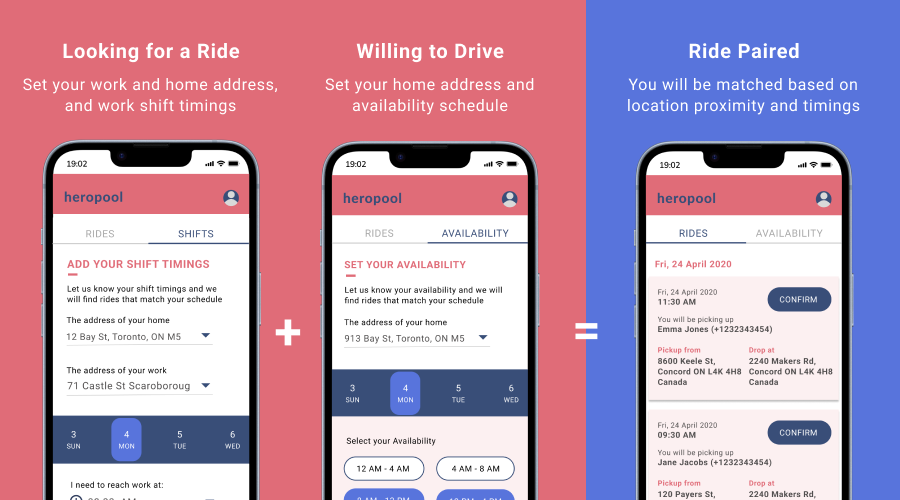
The project moved incredibly quickly. We had a two-week hackathon sprint to take the idea from a problem to a working service concept. That meant constantly balancing what would be valuable for frontline workers with what was technically and operationally feasible. We focused on the core experience:
Who needs a ride? → Who can provide a ride? → Do their schedules and routes align? → Can we make the ride safe?
This helped us avoid overbuilding and concentrate on the experience that mattered most.
What We Learned
The project taught me that product strategy can change dramatically when you get closer to the real problem.
Start with the problem, not the product
Swiftride already had a carpooling product in development, but research showed us that the opportunity had changed. Being willing to pause the existing roadmap allowed us to focus on a much more urgent need.
Simplicity matters in high-pressure situations
Frontline workers were already dealing with an incredibly stressful environment. The product needed to be simple, direct, and easy to understand, especially for people who might not be comfortable with technology.
Research helps turn an assumption into a direction
We initially suspected public transportation was contributing to understaffing. Speaking with care facility managers helped us understand the underlying concerns and gave us a clearer direction for the product.
Move quickly, but validate along the way
Hackathons showed us how quickly a diverse team can turn an idea into something tangible. But mentors and internal assumptions could only take us so far. Usability testing and feedback from actual frontline workers would ultimately determine whether we were solving the right problem.
The Outcome
Our team won First Prize at TogetherVsVirus 2020 and was a Semi-finalist at Hack the Curve, Canada-wide hackathons, for proposing a promising solution to reduce understaffing at care home facilities.
We launched the service with one elderly care facility and looked forward to learning how it could support their staff.
For me, Heropool was a reminder that a product roadmap is never more important than the problem you're trying to solve. Sometimes the most important product decision is knowing when to stop building what you planned—and respond to what people actually need.
